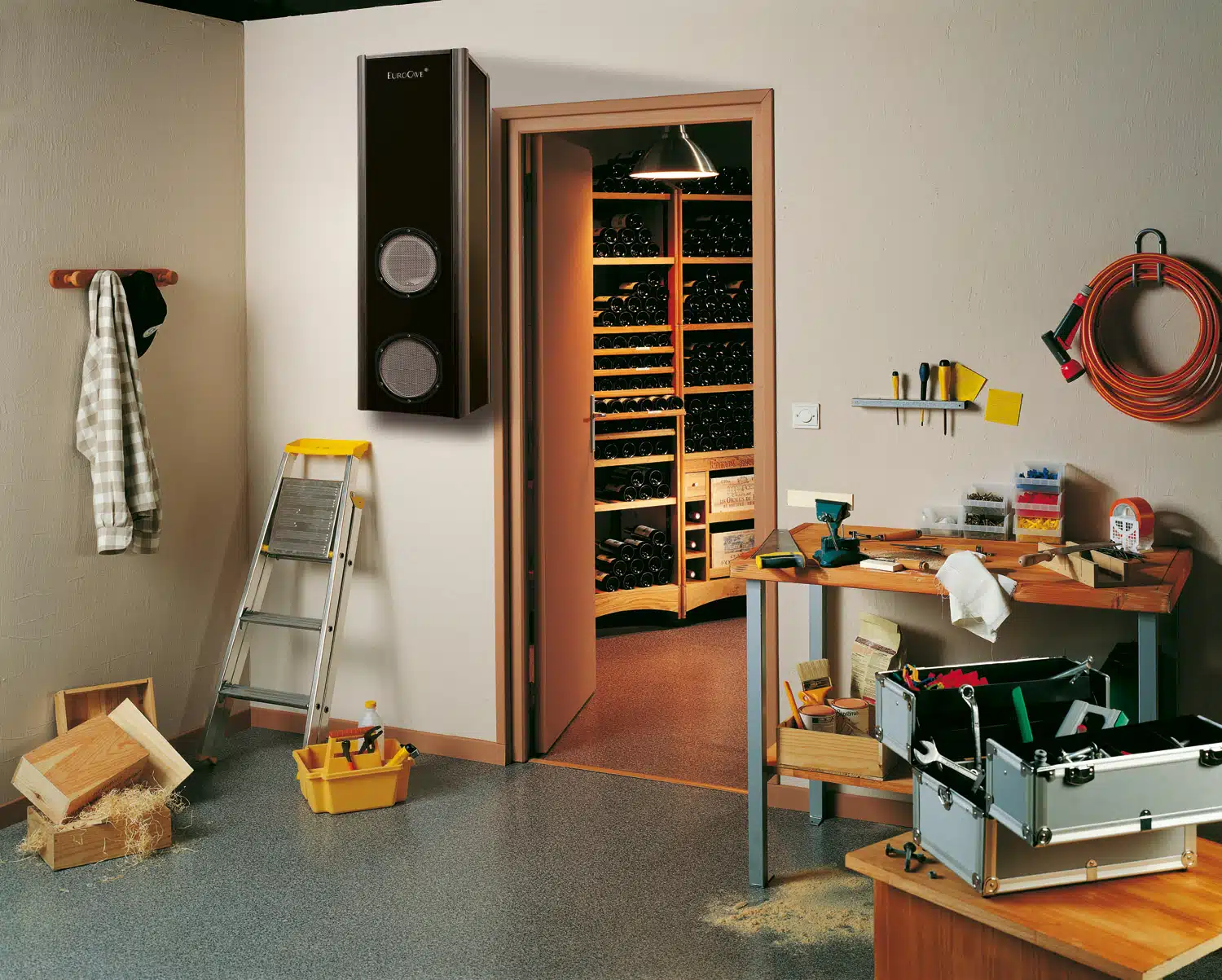
Now you will think, why is EuroCave blogging about glass. Well very easily, for all our customers who want to install a glass partition wall in their wine cellar. We are happy to do it for you, but if you want to do it yourself and don't know much about glass yet, here is the information you need.
U value glass - K value glass
(U value (Netherlands) = K value (Belgium)) It is important to limit heat loss through glazing. This is good for our wallet and good for the environment. To find out how big the heat loss is we will have to look at the U or K value of the glass.
What is the U or K value?
The insulation value of glass is expressed in the U or K value (also called heat transfer coefficient or heat transmission coefficient) and is the amount of heat lost through the glass. The lower the U or K value is, the less heat is lost and thus the better the insulating performance of the glass. The U value is expressed in W/m2 K or the amount of heat (watts) lost through one square meter (m2) of glass at a temperature difference of 1 degree Kelvin (K) between the inside and outside of the glass.
Determination of U or K value
The U or K value of glass is determined by a number of factors:
- The number of glass panes (single, double, triple)
- The cavity filling: dry air or (noble) gas
- The cavity distance: the greater the distance between sheets of glass, the better the insulation
- The possible heat reflective coating on the glass sheet
Glass wall in the wine cellar? What to pay attention to?
If you want to install a glass wall in the wine cellar, it is important to look not only at the U value of the glass, but also at the U or K value of the material used for the frame, or window frames (wood, aluminum or plastic). Aluminum has the highest U value and therefore insulates the least. Plastic has the best insulation value. Wood is in between. Conclusion: The insulation value of the frame and the glass therefore jointly determine the insulation value of the entire glass wall.
Overview U or K values of different types of glazing
- Single glass : 5,7 W/m2K
- Double glazing : approx. 3 W/m2K (depending on cavity and thickness of glass plates)
- HR glass : between 1,6 and 2,0 W/m2K (depending on manufacturer)
- HR+ glass : between 1.2 and 1.6 W/m2K (depending on manufacturer)
- HR++ glass : less than 1,2 W/m2K (depending on manufacturer)
What is insulating glass?
Insulating glass is another name for double glazing. Insulating glass consists of two sheets of glass with a space (cavity) between them. This cavity has an insulating effect and is filled with dry air. Insulating glass is available in several varieties:
- Standard insulating glass (double glazing)
- HR glass
- HR+ glass
- HR++ glass
What is HR Glass?
HR stands for High Efficiency. HR glass works on the same principle as double glazing (also called insulating glass). The only difference with double glazing is the metal layer (coating) and the cavity filled with noble gas (argon or krypton), instead of dry air. The metal layer allows solar radiation to pass through and reflects long-wave radiation. The more effective the metal layer, the better the insulation. Therefore, less energy is then needed to cool the room inside.
Difference between HR, HR + and HR++ glass
To indicate differences in insulation value, a distinction is made between HR, HR+ or HR++ glass.
- HR glass: coated double glass
- HR+ glass: double glazing with coating and argon filling (cavity thickness 9 mm-12 mm)
- HR++ glass: double glazing with coating, argon filling and a wide cavity (cavity thickness 15 mm)
What is tempered glass?
Toughened glass is also known as thermally processed glass. A short and simple description of tempered glass is glass made stronger by chemical or thermal treatment. The glass is heated to about 600 degrees and then cooled rapidly. Because glass is a poor conductor of heat, the outside will heat up faster than the core. Before it can break, the glass is rapidly cooled. This creates a tensile stress between the core and the outside so that the glass sheet holds together. Because of this special toughening process, tempered glass is about 5 times stronger than untoughened glass. Tempered glass does not break easily. And when it breaks, it falls into thousands of chunks that are not as sharp. This makes it much less likely to be injured than untoughened glass. Unhardened glass, when broken, disintegrates into larger, sharp pieces of glass. So tempered glass is much safer than standard glass. Toughened glass is often used as safety glass, for example to prevent falling through. Glass types such as float glass, patterned glass and e.g. solar control glass are all types of glass that can be toughened. Toughened glass can be supplied in various thicknesses. All work on the glass, such as drilling holes, grinding or facet edges, must be done prior to the toughening process. This is because it is not possible to edit glass once it has already been toughened. This creates a risk of breakage.
Source: www.thijssenbv.com