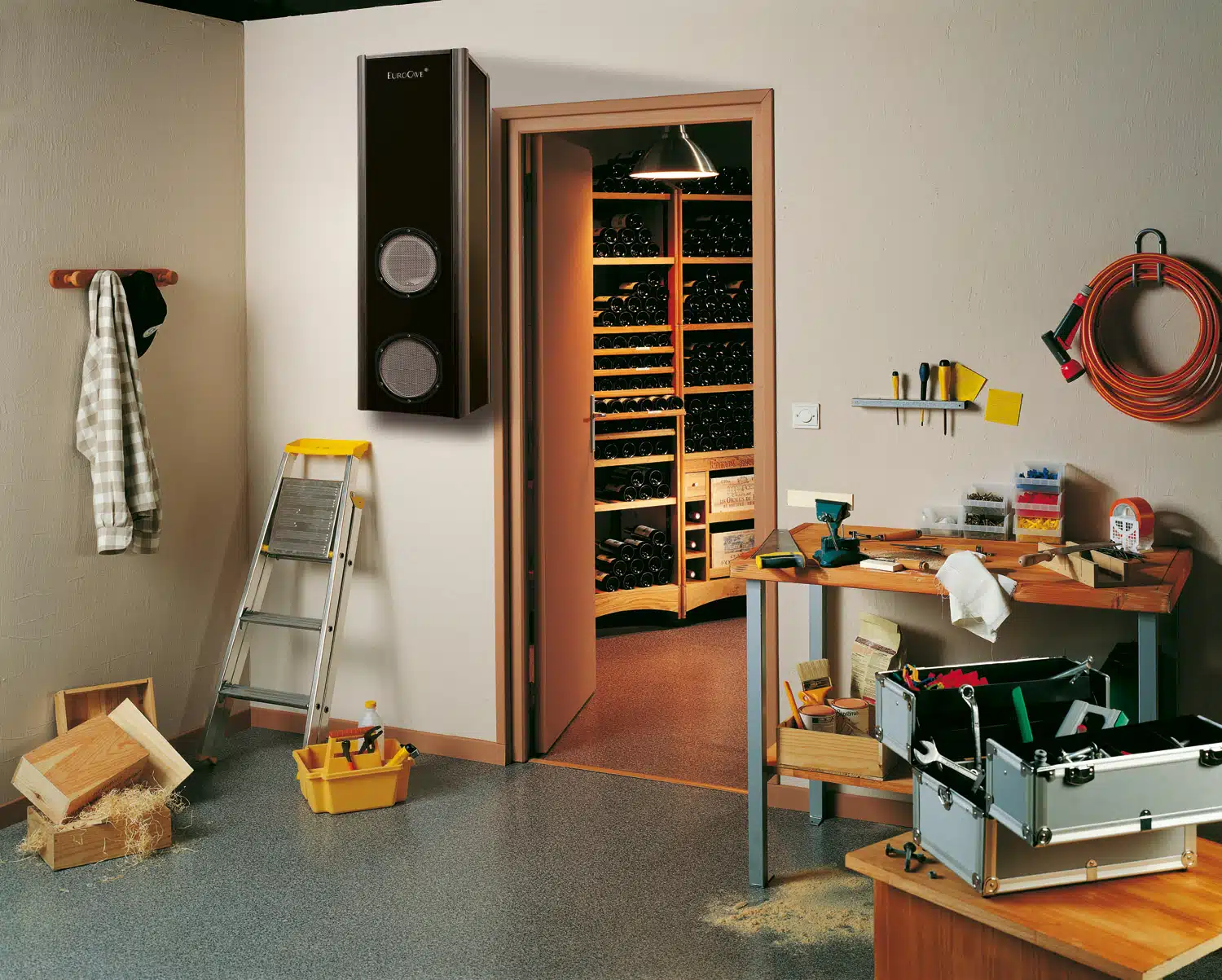
Why serious wine enthusiasts shouldn’t want to be without a climate-controlled wine cabinet—correction: EuroCave .
Seize the day, everyone. My EuroCave is my wine cooler, and my wine cooler is all about instant drinking pleasure. It’s filled with my favorite grape varieties—my top five are Riesling, Cabernet Sauvignon, Chenin Blanc, Chardonnay, and Syrah—but it also includes more obscure wines, from Nerello Mascalese to Savagnin and from Agiorgitiko to Marmajuelo. The beauty of a diverse collection is that you can always surprise yourself. For me, that’s the essence of my wine display cabinet. If you have the space, I’d definitely go for a EuroCave with as much capacity as possible. I have a Pure-L myself, with room for nearly 200 bottles. My only rule is to always keep the wine cabinet well-stocked. Reds on top and whites on the bottom.
Because the great thing about a EuroCave wine cabinet isn’t just that it protects wines from UV rays, vibrations, and temperature fluctuations, but also that it keeps a wide variety of wines at their ideal serving temperature. At the very top of the cabinet, this is 18 degrees; at the very bottom, 8 degrees. And all temperature variations in between. Barolo, Xinomavro, and Sagrantino di Montefalco are at the top, followed by Haut-Médoc, Ribera del Duero, Rioja, and other tannic wines. Next come the Pinot Noirs, Frühburgunders, Crus de Beaujolais, and red wines from the New World. White Bordeaux, Chenin Blanc, white Burgundy (and equivalents from Tasmania and the Adelaide Hills), as well as Grosses Gewächs Riesling and Silvaner, are placed progressively lower down, and at the very bottom you’ll find my collection of champagne and other sparkling wines.
Whatever I’m in the mood for, I take it out of the EuroCave—already at the perfect temperature. And that’s really the only thing I think about when I restock my wine cabinet: making sure to place the new bottles at the right height in the EuroCave , so I don’t have to chill a bottle first when I take one out.
In addition to the EuroCave climate-controlled cabinet, I also have a wine cellar at home that’s climate-controlled by a EuroCave INOA. What’s in there? The honest answer is that I don’t know exactly. Sorry, I’m not the type to stick barcodes on the bottles and update the database every time a bottle is taken out. Compared to that, my cellar is (organized) chaos. Generally speaking, the wines are sorted by country, and the sweet and fortified wines are kept together. But I regularly come across a “forgotten” bottle that I’ve overlooked for years. Sometimes it’s no longer drinkable, but very often it has developed surprisingly well.
Over the years, I’ve seen the selection of wines that make the trip from my “storage” to my home cellar change in tandem with my evolving taste preferences. Ten years ago, there were significantly more reds; these days, there are far more sparkling and white wines. Yes, without wanting to sound pretentious, I’ve become a real champagne fanatic.
And also—which I suppose has something to do with getting older—I’m increasingly moving what I consider my top wines to my home cellar. Grands Crus Classés from 2005, 1982, and my birth year, 1962; prestige cuvées; Rieslings from the 1940s and 1950s; aged vintage ports; and old Tokaji Aszú Essencia—they’re all in my climate-controlled cabinet these days. While I used to be very careful with them—a habit instilled by my upbringing—I now drink them without hesitation. All it takes is the right company.
Carpe diem, everyone—seize the day!
This guest blog was written by Cees van Casteren, MW
Cees van Casteren is a consultant, author, instructor, and freelance journalist. In 2012, he became the second Master of Wine in the Netherlands.
View profile