For all do-it-yourself wine enthusiasts, we have gathered information that may be important to start building your own wine room. In this blog: the insulation values of different materials that can help you keep your wine room at a more efficient temperature. These insulation values can be expressed as L-values, U-values and/or R-values.
L value (lambda value)
The smaller this value is , the better the material insulates. For example, compare a resolution foam insulation board (lambda value 0.024) with a cellular glass insulation board (lambda value 0.050). This means that the latter insulates about half as much and with cellular glass you need double the thickness to obtain the same insulation value as the former.
U-value
This value is usually used for things where you cannot choose a thickness (such as windows). Again, the lower the number, the better insulating. For example, single-pane glass has a U=5.7, while high-efficiency glass has a U=1.1. So HR glass insulates more than 5 times better than single glass.
R-value
R-value or thermal resistance: this can be calculated by dividing the thickness of an insulation material (expressed in meters) by its lambda value. Here, the higher the number, the better insulating.
For different applications in the home, different materials and corresponding thicknesses are needed to obtain the desired insulation. We distinguish between facade - cavity wall insulation and floor insulation.
Facade - cavity wall insulation
The table environmental impact and insulation value for cavity wall insulation gives an overview of the insulation materials used. (Updated from information NIBE, March 2013) *Thickness of material needed at an rc value of 3.5
| Material | Environmental tax | Insulation value | Required thickness in mm* |
| Sheep wool | High (NIBE > 7) | Medium (L-value 0.035) | 120 |
| PUR sheets | Low (NIBE 2b) | High (L-value 0.023) | 82 |
| Glass wool boards | Low (NIBE 1a) | Medium (L-value 0.035) | 120 |
| Cellulose | Medium (NIBE 3a) | Medium (L-value 0.039) | 140 |
| Flax boards | Medium (NIBE 2c) | Medium (L-value 0.035) | 120 |
| Cork boards | Medium (NIBE 4a) | Medium (L-value 0.040) | 140 |
| Rock wool slabs | Low (NIBE 2a) | Medium (L-value 0.035) | 120 |
| EPS plates | Low (NIBE 1c) | Medium (L-value 0.040) | 120 |
| Bio EPS | Low (NIBE 1c) | Medium (L-value 0.038) | 120 |
| Hemp | Low (NIBE unknown) | Medium (L-value 0.040) | unknown |
| Wood fiberboard | Low (NIBE 2c) | Medium (L-value 0.038) | 140 |
| Cellular glass | Low (NIBE 2c) | Medium (L-value 0.040) | 140 |
| Resol foam | Low (NIBE 2b) | High (L-value 0.021) | 76 |
| Metisse | Low (NIBE unknown) | Medium (L-value 0.038) | Unknown |
| XPS plates | Medium (NIBE 4a) | Medium (L-value 0.038) | 140 |
| Supafil | Low (NIBE 1a) | Medium (L-value 0.036) | 30 kg/m³ |
Floor insulation
The table environmental load and insulation value for floor insulation gives you an overview of the insulation materials used. (Updated from information NIBE, March 2013) *Thickness of the material you need at an rc value of 3.5
| Material | Environmental tax | Insulation value | Required thickness in mm* |
| Sheep wool | High (NIBE > 7c) | Medium (L-value 0.041) | 125 |
| PUR sheets | Low (NIBE 5a) | High (L-value 0.025) | 75 |
| Loam | Low (NIBE 1b) | Low (L-value 0.091) | Unknown |
| Glass wool boards | Medium (NIBE 4a) | Medium (L-value 0.034) | 105 |
| Cellulose | Medium (NIBE 4a) | Medium (L-value 0.045) | 135 |
| Flax boards | Medium (NIBE 5a) | Medium (L-value 0.041) | 130 |
| Cork boards | High (NIBE 6c) | Medium (L-value 0.038) | 120 |
| Rock wool slabs | High (NIBE 5a) | Medium (L-value 0.038) | 115 |
| EPS plates | Medium (NIBE 4c) | Medium (L-value 0.034) | 120 |
| Thermos cushions | Low (NIBE 1a) | Low (L-value 0.060) | 75 grams |
| Hemp | Low (NIBE unknown) | Medium (L-value 0.040) | unknown |
| Wood fiberboard | Low (NIBE unknown) | Medium (L-value 0.040) | unknown |
| Cellular glass | High (NIBE 2b) | Medium (L-value 0.040) | unknown |
| Resol foam | High (NIBE 7c) | High (L-value 0.020) | 60 |
Back to the wine room for a moment ...
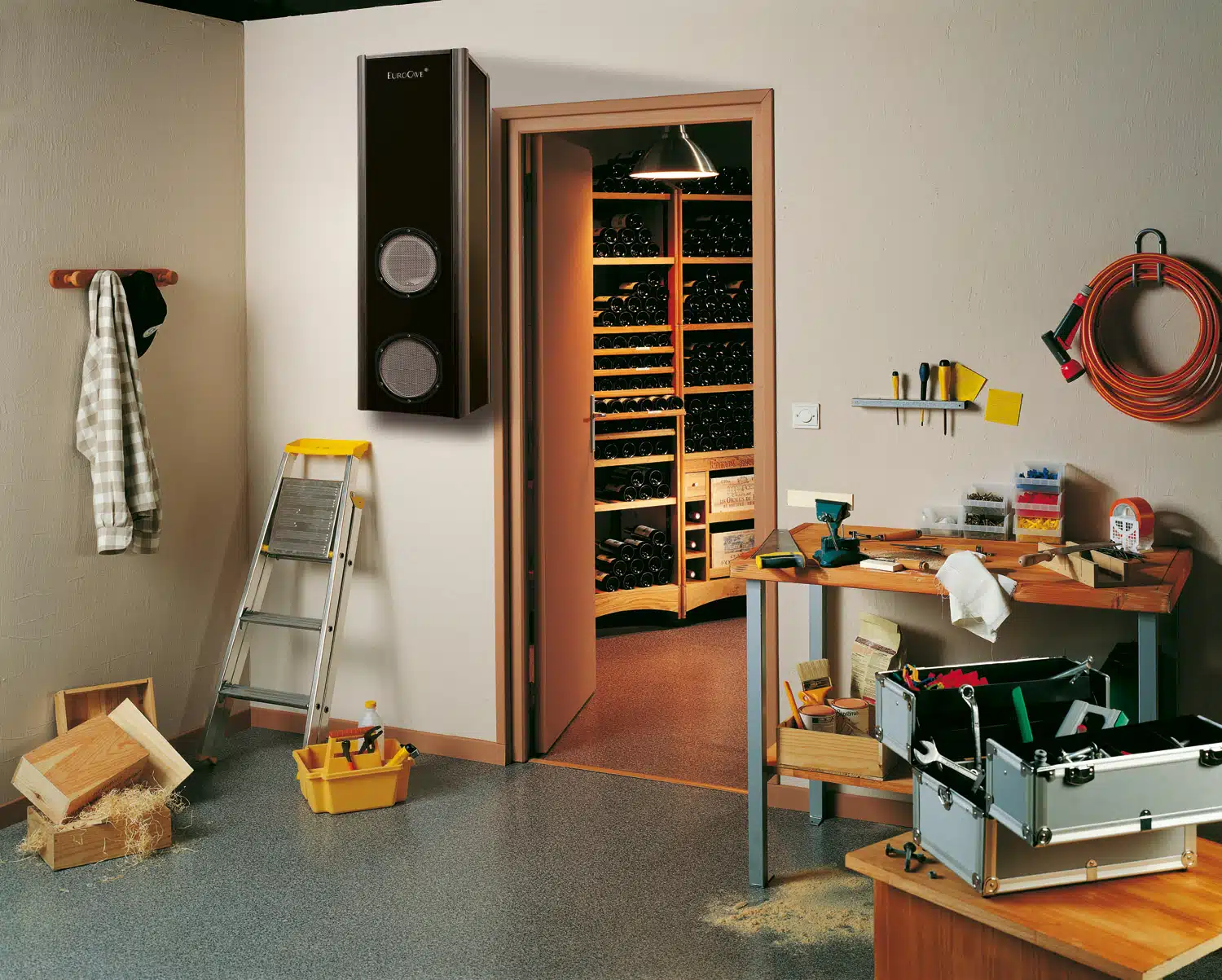
If you want to make an above-ground wine cellar (we call this a wine room), you will always need to install a wine cellar cooling system to get the desired temperature of 12°C. The better you insulate the room, the less the wine cellar cooling system will have to work. Better for the environment and your wallet. However, don't stare blindly at the exact insulation value. Some insulation is always better than no insulation. EuroCave's wine cellar cooling system, the INOA, always has some excess capacity to compensate for a lack of insulation.
Source:Houthetwarm.co.uk